







PIBS Journal June 2026 cover
June 2026 Digital Issue

PIBS Journal

The first digital journal of its kind for paralegals building businesses, paralegals exploring ownership, and the legal industry watching this market take shape. A sharp, editorial look at what paralegals are creating, where the business model is going, and why the conversation matters now. (For the best reading experience, access this issue on desktop.)

Read June’s Features

A curated June issue for the people building, studying, hiring, partnering with, and paying attention to the paralegal business movement.

No Crying on the Yacht visual
Letter from Jaclyn Foster

No Crying on the Yacht

The kind of letter you read when the life you prayed for still feels heavy, holy, hilarious, and a little bit unhinged.

You can cry, wipe your face, and still keep building the life you once prayed for.
Read the letter
From Available to Valuable visual
Live Power Hour Recap

From Available to Valuable

The quiet shift that separates paralegals who stay “available” from paralegals who become impossible to ignore.

Availability is not a business model.
Read the recap
Built With Us in Mind visual
Partner Feature

Built With Us in Mind

When legal tech starts building with freelance paralegals in mind, it is not just a feature. It is a signal.

The tools are finally catching up to the way we already knew this industry was changing.
Read the feature
The Side Gig Era Is Over market report visual
77%primary service is paralegal support
78%reported a secondary service type
65%already have a business name listed
$60median primary hourly rate
Market Report

The Side Gig Era Is Over

The data says what many paralegals have already felt: this is no longer a cute side conversation.

The paralegal “side gig only” era is over. The business owner era has arrived.
Read the market report
Paralegals Have Something to Say visual
June Only Bonus

Paralegals Have Something to Say

For every paralegal who thinks they have nothing to say, this piece is the argument that your voice is part of the business model.

Your content is not just marketing. It is how people experience your judgment before they ever get on a call with you.
Read the bonus feature
Treat It Like Something Real visual
Mini Training

Treat It Like Something Real

If your business feels busy but still fragile, this is the piece that tells you exactly where to look.

A real business cannot grow forever on “I think this is working.”
Read the mini training
Your Business Cannot Grow on Financial Chaos visual
Expert Feature

Your Business Cannot Grow on Financial Chaos

The money side of business feels optional until guessing starts getting expensive.

Every business eventually reaches a point where guessing becomes expensive.
Read the finance feature
The Paralegals in Business Society visual
Join the Society

The Paralegals in Business Society

The place for paralegals who are done treating business ownership like a someday idea.

Build from where you are. Move like you mean it.
See what’s inside
Subscribe to the Journal

Do not miss the next issue of PIBS Journal.

A digital journal for paralegals building businesses, paralegals exploring ownership, and the legal industry paying attention to what paralegals are creating next.

Letter from Jaclyn Foster

No Crying on the Yacht

The kind of letter you read when the life you prayed for still feels heavy, holy, hilarious, and a little bit unhinged.

No Crying on the Yacht visual

No Crying on the Yacht

There is a running joke in my house right now that there is “no crying allowed on the yacht.” The yacht, of course, is a 1992 pontoon, which feels important to clarify because I do not need anyone picturing me drifting around on some massive luxury boat wearing linen and pretending I have life figured out. That is not the vibe. I live a real life. Real kids, snacks, chaos, horses breaking out of fences, sheep screaming at me, and our boat fits in perfectly: something that usually needs a little fixing before the next ride.

But still, the phrase has stuck with me.

No crying on the yacht.

It is ridiculous, which is probably why I love it. It is also weirdly true. Not because life does not give us reasons to cry. It absolutely does. Business does too. Entrepreneurship, motherhood, marriage, money, faith, leadership, responsibility, all of it has stretched me in ways I did not see coming. There have been plenty of seasons where I have cried, questioned everything, prayed desperate prayers, wondered if I was strong enough, and tried to make sense of things that did not feel fair or clear or easy.

But at some point, you learn that you can cry and still keep going. You can be disappointed and still be called. You can have a hard season and still be building something beautiful. You can sit inside a life you once prayed for and still have moments where you feel tired, uncertain, overwhelmed, or humbled by the weight of it.

That, to me, is one of the most honest things about entrepreneurship. It gives you freedom, yes, but it also gives you a front row seat to your own becoming.

Learning How to Fail Well

If I had to choose one piece of personal advice for entrepreneurs, it would not be about finding a niche, creating content, building a funnel, or scaling an offer, even though all of those things matter. It would be this: learn how to fail really, really well.

Learn how to be misunderstood without letting it make you bitter. Learn how to be undervalued without letting it convince you that you are not valuable. Learn how to launch something that does not land and still have the courage to try again. Learn how to pivot when the market shifts, when the timing is off, when the thing you thought would work suddenly does not, or when the door you were counting on closes.

Because business will humble you. People will be rude sometimes. People will underestimate you. Sometimes people will love what you are building, and sometimes it will feel like you are speaking into the void. Sometimes the first try will fall flat. Sometimes the second try will be the thing that opens everything up. Sometimes it will take three, four, or ten tries before you realize what God was teaching you in the process.

I used to think failure meant something was wrong. Wrong strategy. Wrong timing. Wrong offer. Wrong me. I do not think that anymore. I think failure is often where the deeper work happens. It is where your motives get tested. It is where your identity gets separated from your output and you find out whether you only wanted the result, or whether you are actually willing to become the kind of person who can carry the result.

That has been one of the biggest lessons of my life.

The business I prayed for required a version of me capable of carrying it.

The Woman Behind the Business

Not a perfect version. I am not perfect now, and I was definitely not perfect when I started. But a steadier, more grounded person. A woman who could be disappointed without letting disappointment become her identity, who could be rejected without spiraling into “maybe I am not enough.” A woman who could build, lead, mother, love, surrender, and keep showing up even when things felt heavier than expected.

When I look back over the years, I can see so clearly that the greatest work God has done in my life was not really in my business. The business may be the thing people can see from the outside. They can see the clients, the revenue, the acquisition, the opportunities, the stages, the partnerships, the title, the posts, and the wins. But that was never the whole story. The real story was what God was doing in me while all of that was happening.

He was teaching me patience when I wanted immediate results. He was teaching me faith when I wanted certainty and how to surrender when I wanted control. He was teaching me humility when I wanted to prove myself and that my worth was never supposed to be tied to revenue, recognition, performance, titles, approval, or applause.

Motherhood, Grace, and Becoming

Motherhood, especially, has revealed parts of me that business never could. There is nothing like raising children to show you your own heart in real time. It reveals your patience and your impatience. Your softness and your selfishness. Your capacity for love and your desperate need for grace. It has made me more tender, more aware, more prayerful, and more committed to building a life that does not require me to constantly choose between being present for my children and pursuing the work I feel called to do.

That is another part of this conversation that matters to me.

I did not become an entrepreneur because I wanted to work less. I do not think most serious entrepreneurs do. In many ways, entrepreneurship asks more of you than a traditional job ever will. It asks you to make decisions without guarantees and to sell your ideas before anyone else believes in them. It asks you to be responsible for your own momentum and to hold uncertainty and still act. It asks you to be creative, disciplined, resilient, and honest with yourself in ways that can be deeply uncomfortable.

But I did become an entrepreneur because I wanted my life to feel more like mine.

Building a Life, Not Just a Business

The average person gets about 674,000 hours on earth. A huge portion of those hours will be spent sleeping. Another huge portion will be spent working, commuting, getting ready for work, thinking about work, worrying about work, recovering from work, or dreading Monday. And listen, this is not an anti-work statement. I believe work matters. Money obviously matters, like a lot. Responsibility matters. Providing for your family matters. Contributing to the world matters. There is dignity in work, and there is purpose in using your gifts well.

But at some point, I realized I did not want my actual life to exist only in the margins between obligations.

I did not want to give the best of my energy to survival and then hand whatever scraps were left to my family, my faith, my home, my health, and myself. I did not want to build a life where everything I loved had to fit around everything I was required to do. I wanted work and life to coexist instead of constantly competing for the same exhausted version of me.

Entrepreneurship gave me that. Not perfectly and definitely not instantly or without sacrifice. But it gave me the ability to design. It gave me the ability to ask, “What kind of life are we actually building here?” It gave me the ability to make choices around my family, my values, my energy, and my calling instead of blindly accepting that the only way to succeed was to stay on a path that was quietly costing me too much.

The Kind of Freedom That Actually Matters

That kind of freedom is not always glamorous. Sometimes it looks like taking calls from the car. Sometimes it looks like working after bedtime. Sometimes it looks like building something during nap schedules, school pickups, sports practices, sick days, and seasons where nobody in the house can find their shoes. Sometimes it looks like faith and grit and a very messy kitchen. Sometimes it looks like crying for a minute, but of course, not on the yacht, wiping your face, and doing the next thing.

But it is still freedom.

It is the freedom to build a business around your life instead of building your life around someone else’s business that does not love you back. It is the freedom to be present for the moments that matter. To take the trip, answer the call, sit outside with your kids, pray in the middle of the day, change direction when something is not working, and create something that reflects who you are instead of constantly trying to become who a workplace, an industry, or someone else’s expectations told you to be.

And that freedom has been worth every hard day it took to get here.

Let God Work on You While You Build

Waiting is never a punishment, and maybe that is the real lesson.

Roll with the punches, yes. Learn how to fail well, absolutely. Pivot when you need to. Try again when something does not work. Let people misunderstand you without handing them the pen to your story. Build the thing even when it feels slow. Keep going when the market changes, when the offer flops, when the answer is not yet, when the season is stretching you, and when you are tempted to believe that a hard chapter means the whole story is falling apart.

But also let God work on you while you build.

Let Him shape the person behind the business. Let Him steady your hands, soften your heart, strengthen your faith, correct your motives, deepen your patience, and remind you that your worth was never up for negotiation in the first place.

Because the goal is not just to get the business you prayed for. The goal is to become the person who can carry it with grace.

Steady Enough for What Comes Next

So if this season feels messy, I hope you do not automatically assume that means you are off track. You might be getting stretched. You might be getting prepared. You might be learning how to fail without quitting, wait without losing faith, and build without losing yourself.

And one day, you may look back and realize this was not the season where everything fell apart. It was the season where you became steady enough to hold what came next.

Until then, roll with the punches.

Keep your faith bigger than your fear.

Let the hard days teach you without letting them define you.

Because there is no crying allowed on the yacht.
Keep the issue coming

Read the next one first.

Get future PIBS Journal issues, market notes, strategy, and featured conversations sent straight to your inbox when a new issue drops.

Live Power Hour Recap

From Available to Valuable

The quiet shift that separates paralegals who stay “available” from paralegals who become impossible to ignore.

From Available to Valuable visual

FROM AVAILABLE TO VALUABLE: THE PARALEGAL BUSINESS MINDSET SHIFT

There is a moment inside every growing business where the questions start to change.

At first, the questions are usually about getting started. How do I find clients? What should I charge? What should my website say? What do I say when I reach out to an attorney? How do I explain what I do without sounding awkward? How do I get someone, anyone, to take me seriously?

Those questions matter. They are the beginning questions. They are the questions you ask when you are still trying to prove to yourself that this thing is possible.

But inside Paralegals in Business, I have been watching something shift.

The questions are becoming more sophisticated.

They are no longer only about getting hired. They are about being taken seriously as a business. They are about building something sustainable, professional, profitable, and structured enough that attorneys can rely on it.

And honestly, that is where the real growth begins.

From Available to Valuable

A lot of paralegals start their businesses thinking the main goal is to be available. Available for overflow work. Available for a busy attorney. Available for the client who needs something done quickly. Available for whatever comes in because, in the beginning, the win feels like getting the work at all.

But availability is not a business model.

Availability might get you started, but it cannot be the thing your entire business is built on. At some point, you have to move from “I can help with that” to “Here is how I help, here is how we work together, and here is what makes this experience easier for you.”

That is the shift from freelancer to business owner.

A freelancer often waits for the client to define the need. A business owner learns how to see the need, name the need, and build a service around solving it.

This shows up in the way paralegals are asking about existing clients. How do I get more work from someone who already trusts me? How do I turn a sporadic client into something more consistent without being pushy? How do I help an overwhelmed attorney delegate when they are too busy to even think through what to delegate?

Those questions are not small. They are not beginner questions. They show a deeper understanding of how attorneys operate.

Most attorneys are not holding back work because they have nothing to send. They are holding back work because delegation itself feels like work. They have to stop, explain, gather, organize, prioritize, and trust that the person on the other side can actually run with it. When a firm is already overwhelmed, even getting help can feel like one more thing to manage.

That is why the strongest paralegal business owners do not simply say, “Let me know if you need anything.”

They make the next step easier.

They say, “Here are three things I can take off your plate right away.”

They reduce the mental load. They make delegation feel lighter. They bring structure into the chaos instead of waiting for the attorney to hand them a perfectly organized assignment.

That is value.
Not just availability.

Pricing Like a Business Owner

The same shift is happening around pricing.

Almost every paralegal business owner has had that moment where an attorney asks, “What are your rates?” and suddenly your entire nervous system forgets how to act normal.

It is even harder when the question comes early. Before a discovery call. Before you have explained the value. Before they know your experience, your process, or how much easier their life could be with the right support.

The temptation is to either avoid the question completely or blurt out a number and hope they do not disappear.

But pricing like a business owner requires more than giving a number.

It requires positioning.

That does not mean being vague or playing games. People want price transparency, and I understand that. Nobody wants to waste time on a call just to find out something is wildly outside their budget.

But there is a difference between answering the question and reducing your entire value to an hourly rate in a message thread.

A stronger answer gives a range or starting point while also explaining what the client is actually buying. They are not just buying time. They are buying judgment, experience, reliability, reduced training, faster turnaround, fewer things sitting untouched, and support that does not require the overhead of another employee.

That matters.

Because if you only present your rate as a number, the attorney will compare it to other numbers. Maybe an employee wage. Maybe a cheaper contractor. Maybe an offshore option. Maybe what they paid someone five years ago.

But when you present your service as a solution, the conversation changes.

The point is not to convince every attorney to afford you. Some will not. Some are not ready. Some do not have the cash flow. Some are still thinking like employers trying to control a payroll expense instead of business owners investing in support.

That does not mean your price is wrong.

It means you have to stop making every reaction to your price mean something about your worth.

That is a business owner lesson.

The Real Product Is Relief

Underneath all of these questions is one common theme: paralegals are learning that they are not just selling tasks.

They are selling relief.

That is what attorneys really want.

They want the work to move. They want the file cleaned up. They want the draft started. They want the client updated. They want the deadline handled. They want the thing they keep thinking about at 10 p.m. to finally be off their plate.

But relief does not happen by accident. It happens when the paralegal has structure, confidence, boundaries, and a process that makes working together feel easier.

That is where the industry is going.

Not toward random side gigs or where paralegals are waiting around to be picked. Not toward “I can do whatever you need” as the entire business strategy.

The future belongs to paralegals who can think like business owners. Paralegals who understand the attorney’s pain points, but also understand their own value. Paralegals who can offer support without becoming chaotic. Paralegals who can be flexible without being boundaryless. Paralegals who can make life easier for the client without making the business unsustainable for themselves.

That is the part that excites me most. Because the questions are changing, and when the questions change, it means the people asking them are changing too.

Paralegals are no longer just asking if this is possible. They are asking how to do it well.

And that is exactly how an industry begins to shift.

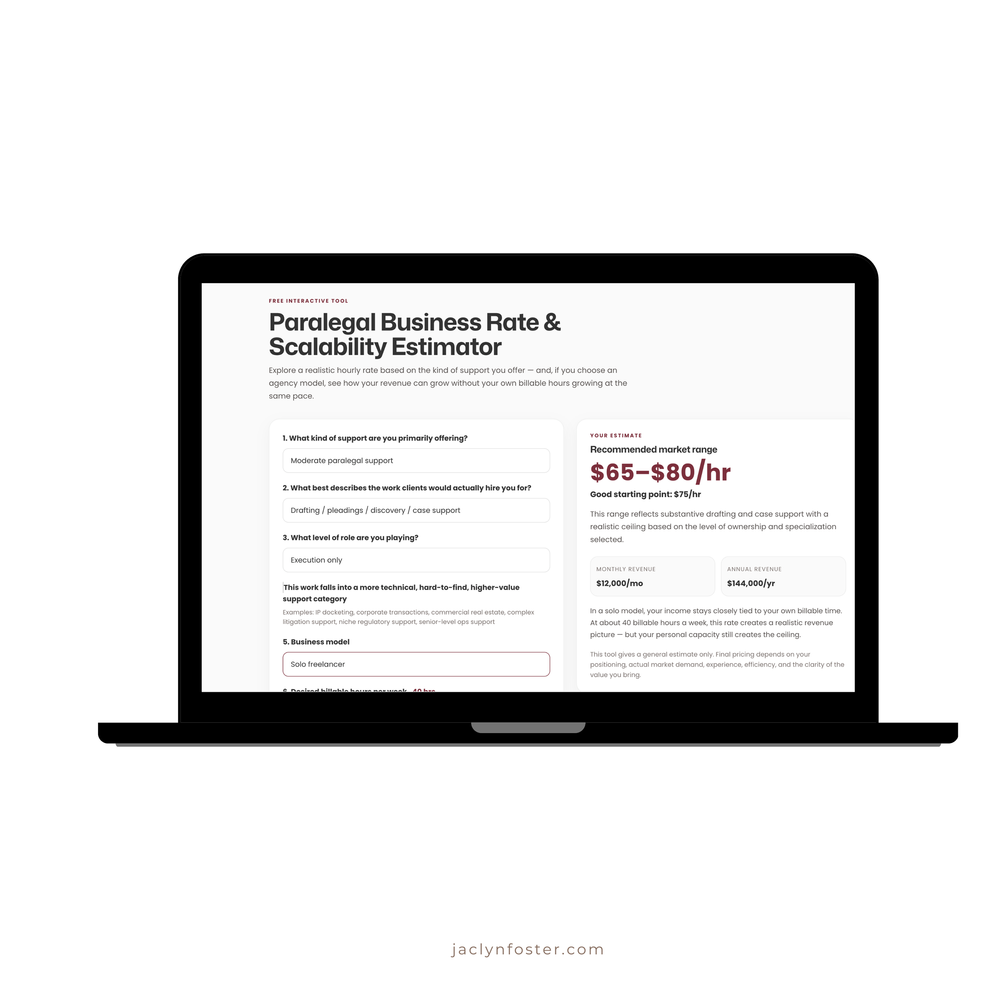
Use the free Rate & Revenue Calculator

Keep the issue coming

Read the next one first.

Get future PIBS Journal issues, market notes, strategy, and featured conversations sent straight to your inbox when a new issue drops.

Partner Feature

Built With Us in Mind

When legal tech starts building with freelance paralegals in mind, it is not just a feature. It is a signal.

Built With Us in Mind visual

Built With Us in Mind

Do you know how I know paralegal businesses have officially arrived in this industry?

Because legal technology is starting to be built with us in mind.

Not as an afterthought. Not as a workaround. Not as “maybe a virtual assistant could use this too.” But actually with the freelance paralegal, the fractional legal professional, and the remote collaboration model considered from the beginning.

That is what stood out to me when I first met with Joe Girellini, founder of LawOffice.AI.

As he walked me through the platform, he said they wanted to make sure their law firm case management system was being built with freelance paralegals and remote collaboration in mind.

And honestly, I got chills.

Because that is not just a software feature. That is a sign of where this industry is going.

For years, paralegal business owners have been piecing things together. One tool for contracts. One for invoicing. One for timekeeping. One for documents. One for tasks. One for communication. Then add in whatever system the law firm uses, or does not use, and suddenly the backend of the business becomes a full-time job on its own.

LawOffice.AI feels different because it brings so much of that operational side into one place: contracts, invoicing, timekeeping, document signing, contact management, task organization, and the structure both law firms and paralegal business owners need to keep legal work moving.

But what really caught my attention was the collaboration side.

Flat-fee project tracking. Limited-scope workflows. Centralized case details. Remote attorney collaboration. AI-powered case summaries. Timeline creation. Faster onboarding.

Those are not just bells and whistles. Those are the exact things that matter when a paralegal business owner is trying to serve law firms professionally, securely, and without everything living in eight different places.

To me, that is the bigger story.

This is not just about a cool tool. It is about the industry recognizing that legal work is becoming more flexible, more distributed, and more collaborative. Law firms are not only hiring full-time, in-office employees anymore. They are working with experienced paralegals who run real businesses and need systems that support that kind of relationship.

And yes, I think law firms should be looking at this too.

Because better systems do not just make the paralegal look more professional. They make the work move better. They make onboarding cleaner. They reduce confusion. They create visibility. They help both sides operate with more confidence.

That is why this partnership matters to me.

LawOffice.AI is not just another AI tool trying to capitalize on a trend. It feels like a real operating system for modern legal work.

And maybe the most exciting part is this:

The tools are finally catching up to the way we already knew this industry was changing.

Learn more here

Learn more about LawOffice.AI
Keep the issue coming

Read the next one first.

Get future PIBS Journal issues, market notes, strategy, and featured conversations sent straight to your inbox when a new issue drops.

Market Report

The Side Gig Era Is Over

The data says what many paralegals have already felt: this is no longer a cute side conversation. It is a market.

The Side Gig Era Is Over market report visual
77%primary paralegal support
78%secondary service type
65%business name listed
$60median hourly rate

The Side Gig Era Is Over

State of the Paralegals in Business Market

There is a difference between a trend and a market.

A trend is people talking about something online. A market is when people start building businesses around it, pricing services around it, buying tools for it, developing specialties inside it, and making career decisions because of it.

Based on the latest Paralegals in Business Society member profile data, this is no longer a cute little side conversation happening in the legal industry.

This is a market.
And it is getting more serious.

The data shows what I have been seeing anecdotally for years: paralegals are no longer simply asking whether freelance legal support is possible. They are organizing around it. They are naming businesses. They are building websites. They are choosing practice areas. They are pricing services. They are positioning themselves beyond “extra help” and into actual business ownership.

In this sample of The Paralegals in Business Society member profiles, 77% identified paralegal support as their primary business or service type. That matters because this is not a vague virtual assistant market trying to squeeze into legal. This is a market being led by legal professionals with real legal experience, real practice area knowledge, and a clear desire to serve law firms in a more flexible way.

Even more interesting, 78% reported having a secondary business or service type. That tells me these businesses are not being built as one-dimensional task shops. Paralegals are layering in adjacent support: legal assistant services, law firm consulting, client intake, legal tech, notary services, and other operational support.

That is the first major signal.

Paralegal businesses are becoming more sophisticated.

They are not just saying, “I can draft pleadings.” They are starting to ask, “How do I support the full operational reality of a law firm?”

And that is a very different conversation.

The Experience Is Turning Into Offers

One of the biggest misconceptions about this market is that paralegal business ownership only “counts” once someone has a massive resume, a perfect plan, or decades behind them.

That is not the real story.

The real story is that legal skill is being packaged in more intentional ways. Some paralegals are building from deep practice-area experience. Some are building from a few strong service lanes. Some are starting carefully on the side while they learn how to price, position, and communicate their value.

What matters is not pretending every paralegal business has to look the same. What matters is that more paralegals are learning how to turn their experience, judgment, and practical knowledge into a business model attorneys can understand and hire.

That is where the market gets exciting.

Practice Area Depth Is Becoming a Competitive Advantage

The strongest paralegal businesses are not built on “I can do anything for anyone.”

They are built on focus.

The most represented primary practice areas in the data were civil litigation, family law, personal injury, estate planning and probate, criminal law, business and corporate law, and real estate law. When primary, secondary, and additional practice areas were combined, civil litigation appeared most often, followed by personal injury, family law, estate planning and probate, business and corporate law, contract drafting and review, real estate law, and criminal law.

That spread tells an important story.

The market is not forming around one narrow legal niche. It is forming across the practice areas where law firms consistently need trained support, consistent file movement, drafting help, client communication, case organization, and operational relief.

Even more telling, 83% of respondents listed experience across more than one practice area.

That does not mean everyone should market themselves as a generalist. In fact, I usually believe the opposite. But it does show how much experience is sitting inside this market. These are not people learning law firm work from scratch. These are professionals with years of transferable knowledge who are now deciding how to package it.

That is where the opportunity is.

Not just in doing the work.

In positioning the work.

Rates Are Still Catching Up to the Value

Pricing is where the market gets interesting.

Among the respondents who provided a usable hourly rate, the median primary rate was $60 per hour, with an average of about $66.50. About 36% were charging $75 or more, while roughly 30% were still under $50.

That tells me the market is maturing, but it is not fully there yet.

There is still a gap between the level of experience in the market and the way many paralegal business owners are pricing that experience.

And I understand why.

Pricing is emotional, especially for paralegals who came out of traditional employment structures where someone else decided what their work was worth. It takes time to unlearn employee pricing. It takes time to understand that a freelance rate is not the same as a W2 wage. It takes time to account for taxes, overhead, admin time, software, business development, unpaid time, and the fact that a law firm is not carrying the same employment burden when they hire a business.

But this is exactly why the next stage of the market will be defined by business education, not just legal skill.

The paralegals who learn how to price based on value, capacity, profitability, and positioning will separate themselves.

Not because they are better people.

Because they are treating the business like a business.

The Business Infrastructure Is Forming

Another strong signal: 65% of respondents already had a business name listed, and 43% had a website.

That is not everyone, of course, but it is enough to show that this is not just a population of people casually thinking about maybe freelancing someday. Many are already creating external business identities.

That matters because markets become real when people start building infrastructure around them.

Names. Websites. Offers. Tools. Processes. Practice areas. Pricing. Lead sources. Client onboarding. Referral relationships. Software. Community. Training.

That is how a professional category becomes visible.

And the current journey data shows this market is very much in motion. About 28% of respondents are already launched or operating. Another 36% are in the launching or transitioning stage. Another 32% are designing or preparing to launch.

Only a tiny percentage are still in pure exploration mode.

That is a major shift.

Before joining PIBS, the largest group was in the “daydreaming” phase, consuming information and thinking about the possibility. Now, the center of gravity has moved toward designing, launching, transitioning, and operating.

In other words, people are moving.

They are not just consuming content about building paralegal businesses. They are becoming the market.

The Future Belongs to Operators

The next wave of this industry will not be led by the paralegal who is simply willing to take extra work.

It will be led by operators.

By paralegal business owners who know their numbers. Who understand their capacity. Who can identify profitable services. Who know where their best leads come from. Who can explain their value to a law firm without shrinking. Who build client experiences that feel professional, secure, and easy to work with.

That is the difference between a paralegal side gig and a paralegal business.

And to be clear, there is nothing wrong with starting on the side. A lot of people have to. A lot of people should. The issue is not whether the business is full-time or part-time.

The issue is whether it is being treated like something real.

Because the data is telling us something very clearly.

This market is not theoretical anymore.

Experienced legal professionals are entering it. They are naming businesses. They are building websites. They are serving multiple practice areas. They are layering services. They are charging professional rates, even if many still have room to grow. They are moving out of the “is this possible?” stage and into the “how do I build this well?” stage.

That is the real state of the Paralegals in Business market.

It is early, active, and experienced. It is underpriced in places, but it is more sophisticated than people think. And it is only getting stronger.

The paralegal “side gig only” era is over.

The paralegal business owner era has arrived.

Data reported was from The Paralegals in Business Society Active Membership Network of 290 members.

Keep the issue coming

Read the next one first.

Get future PIBS Journal issues, market notes, strategy, and featured conversations sent straight to your inbox when a new issue drops.

June Only Bonus

Paralegals Have Something to Say

For every paralegal who thinks they have nothing to say, this piece is the argument that your voice is part of the business model.

Paralegals Have Something to Say visual

Paralegals Have Something to Say

June Only - Paralegals in Business Society Bonus

One of the biggest lies paralegals tell themselves when they start building a business is that they have nothing to say.

No attorney cares what I think.

Someone with more experience is going to laugh at me.

Everything has already been said before.

I do not know how to market myself without sounding salesy, awkward, or obvious.

I know that spiral because I lived in it for a long time. I sat on the idea of starting my business because I knew, at some point, marketing meant letting people hear from me. Not just hiding behind my resume. Not just waiting for someone to notice I was good at the work. Not just subcontracting in the background for $12 to $20 an hour and hoping someone else would keep feeding me assignments.

Eventually, I had to stop hiding.

And honestly, the first content I put out was not perfect. Some of it was probably terrible. There were awkward blogs, stiff salesy posts, and a whole lot of “done is better than perfect” energy.

But within a month, I got my first attorney client.

Within six months, I was at capacity and hiring.

Three years later, my business hit a $500,000 year.

Four years later, I sold it.

Not because every post was brilliant. Not because I had some perfect content strategy from day one. But because I finally started letting people see how I thought.

That is the thing I want more paralegals to understand.

Your content is not just marketing.

It is how people experience your judgment before they ever get on a call with you. It is how attorneys begin to understand what you know, how you think, what problems you solve, and why your perspective matters. It is how you build trust before the discovery call. It is how you fill your funnel without constantly chasing people one by one.

And yes, content is a long game.

It compounds.

The post you write today might not bring in a client tomorrow. But over time, consistency builds authority. Authority builds trust. Trust creates opportunity. And opportunity is what turns a quiet little business idea into something real.

That is why the June Paralegals in Business Society bonus is The Paralegal Authority Lab.

Existing members and new members who join in June will receive lifetime access to this tool.

The Paralegal Authority Lab is a writer’s block relief tool for paralegals and legal support business owners who need a strong content angle in the moment, without staring at a blank page or writing another generic “3 tips” post.

And most importantly, it is designed to help you keep your voice.

Because nobody needs more obvious AI-written content floating around LinkedIn. The goal is not to hand your voice over to a robot. The goal is to use AI as a creative partner so you can get unstuck, sharpen your angle, and say the thing in a way that still sounds like you.

At the bottom of your prompt outputs, you will also see extra features to help you keep going:

Give me 15 more ideas like this

Turn this into a LinkedIn story flow

Does AI know my brand?

That means one idea can become a full content direction. One rough thought can become a stronger angle. One stuck moment can turn into a post that actually sounds like you and speaks to the kind of clients you want to reach.

Because paralegals do have something to say.

You have opinions. You have experience. You have insight from inside the legal industry. You know where law firms are dropping balls. You know where clients are frustrated. You know where attorneys are overwhelmed. You know what good support looks like because, in many cases, you have been the one holding the whole operation together.

That is not nothing.
That is authority.

And the more you learn how to communicate that authority, the more your business starts to feel real to everyone else too.

So if you are already inside The Paralegals in Business Society, this bonus is yours for June.

And if you join in June, you will get it too.

You will have it forever.

Because your voice matters.

And it is time to stop acting like it does not.

Keep the issue coming

Read the next one first.

Get future PIBS Journal issues, market notes, strategy, and featured conversations sent straight to your inbox when a new issue drops.

Mini Training

Treat It Like Something Real

If your business feels busy but still fragile, this is the piece that tells you exactly where to look.

Treat It Like Something Real visual

Treat It Like Something Real

There is a difference between having a paralegal business and actually treating it like a business.

And I do not say that to shame anyone. A lot of businesses start messy. Mine did too. Sometimes you are building in the margins of a full-time job, motherhood, financial pressure, client work, burnout, or pure survival mode. Sometimes it is a side gig in the beginning because that is what it needs to be.

That is fine.

But even if your business starts as a side gig, it cannot be treated like something random if you want it to become something stable.

At some point, you have to stop throwing spaghetti at the wall and hoping something works. You have to stop making every decision based on vibes, panic, excitement, fear, or whether you “feel busy.” Because feeling busy does not always mean the business is healthy. A full calendar does not always mean you are profitable. A good month does not always mean your marketing is working. A slow month does not always mean everything is falling apart.

That is why business awareness matters.

Not complicated analytics. Not obsessive bookkeeping. Not some overwhelming spreadsheet that makes you want to shut your laptop and go stare into the woods.

Just awareness.

Where are your leads actually coming from? Which marketing efforts are turning into real conversations? How many consults are becoming clients? Which services are bringing in the most profit, not just the most activity? Are your clients staying? Are they expanding? Are they leaving? Are you growing in a way that is sustainable, or are you quietly building a business that depends on you being stretched too thin all the time?

These are the questions that move you from “I hope this works” to “I can see what is happening.”

And that is a different level of ownership.

Because when you know your numbers, you stop guessing. You stop assuming that the loudest problem is the biggest problem. You stop chasing every shiny marketing idea just because someone else said it worked for them. You stop undercharging because things feel slow, or overcommitting because things feel exciting.

You start making decisions like a CEO.

That might sound dramatic, especially if your business is still small. But honestly, that is when it matters most. The habits you build when the business is small are the habits that either support growth later or make growth feel chaotic when it finally comes.

If you do not know where your best leads come from, you will waste energy on the wrong platforms. If you do not understand your conversion rates, you may think you need more visibility when what you actually need is a stronger sales process. If you do not track retention, you may keep celebrating new clients while ignoring the fact that clients are quietly cycling out. If you do not pay attention to capacity, you may mistake burnout for success.

And that is the danger.

A paralegal business can look busy from the outside while being fragile underneath.

This is why treating your business like something real matters. It gives you information. It gives you confidence. It gives you the ability to make smarter decisions before you are forced to make desperate ones.

It does not mean you have to become a numbers person overnight. It does not mean you need to track every tiny detail or turn your business into a corporate dashboard. It just means you are willing to look at the truth of what is happening so you can build something that lasts.

Because long-term success is not built on guessing.

Scalability is not built on chaos.

And a real business cannot grow forever on “I think this is working.”

At some point, you have to know.

That is when things start to shift. You are no longer just hoping the business survives. You are paying attention to what it needs. You are learning its patterns. You are seeing what is profitable, what is draining, what is converting, what is sustainable, and what needs to change.

That is not boring.

That is power.

Because the more clearly you can see your business, the more confidently you can lead it.

And that is the difference between a paralegal who is just staying busy and a paralegal business owner who is building something real.

Join PIBS now

Join PIBS to access the tracking tool
Keep the issue coming

Read the next one first.

Get future PIBS Journal issues, market notes, strategy, and featured conversations sent straight to your inbox when a new issue drops.

Expert Feature

Your Business Cannot Grow on Financial Chaos

The money side of business feels optional until guessing starts getting expensive.

Your Business Cannot Grow on Financial Chaos visual

Your Business Cannot Grow on Financial Chaos

There is a stage in business ownership where you realize the work itself is only one part of the business.

For paralegals, this can feel especially true because most of us come into entrepreneurship through the skill. We know how to support attorneys. We know how to move files. We know how to draft, organize, calendar, communicate, problem-solve, and keep legal work from falling apart behind the scenes.

So when we start a business, the first layer feels obvious enough: get clients, do good work, get paid.

But then the business starts asking more of you.

Not just legally.

Not just financially.

But mentally.

At some point, you realize you are not only making money. You are making decisions with money. You are choosing how to structure the business, how to pay yourself, how to separate business and personal finances, how to plan for taxes, how to think about profit, how to protect what you are building, and when to stop winging it and bring in real professional guidance.

Those decisions start on day one, whether we realize it or not.

They show up when you decide whether this is “just a little side thing” or something you are going to treat seriously from the beginning. They show up when you open your first business bank account, set aside money for taxes, track expenses, choose whether to form an LLC, or finally admit that the shoebox of receipts and random Venmo transfers are not exactly a business strategy.

And they keep showing up as the business grows.

The questions change. What worked when you had one small client may not work when you have five. What made sense when you were earning a few hundred dollars a month may not make sense when the business becomes real income. The structure that felt “good enough” in the beginning may need to evolve when your profit grows, your risk changes, your services expand, or your goals become bigger.

That is why financial clarity matters so much.

Not because every paralegal business owner needs to become obsessed with taxes. Not because anyone needs to turn into a spreadsheet person overnight. And definitely not because the financial side should become more intimidating than it already feels.

It matters because every business eventually reaches a point where guessing becomes expensive.

Guessing what you owe.

Guessing what you can afford.

Guessing whether you are profitable.

Guessing whether your structure still fits.

Guessing whether the decision you saw someone else make online is actually right for your business.

That kind of guessing keeps you reactive. It makes tax season feel like a surprise. It makes growth feel heavier than it needs to. It can make a business that looks successful from the outside feel chaotic behind the scenes.

And the truth is, a paralegal business can be simple without being sloppy.

It can start small without being treated casually.

It can be a side business while still being structured like something real.

That is the shift.

The goal is not to have every answer immediately. The goal is to understand that your business will keep evolving, and your financial decisions have to evolve with it. There may be a season where a simple structure makes sense. There may be a season where an LLC becomes important. There may be a season where an S corp conversation is worth having. There may be a season where DIY bookkeeping is fine, and another where avoiding your books is costing you more than a bookkeeper ever would.

Business ownership is not one decision.

It is a series of decisions that get more important as the business grows.

That is why conversations like the one inside Paralegals in Business Society with CPA and financial strategist Sarah Mulder matter. Not because tax strategy is the most exciting topic in the world, although honestly, keeping more of what you earn is pretty exciting. But because paralegals building businesses deserve to understand the financial side of what they are creating.

They deserve plain-English guidance. They deserve to know what questions to ask. They deserve to stop feeling like taxes, structure, and money decisions are some mysterious world they are supposed to figure out after they are already overwhelmed.

Because long-term freedom requires more than clients.

It requires clarity.

And if you are building a business for more income, more control, more flexibility, and more ownership over your career, the financial foundation cannot be an afterthought forever.

At some point, the business has to grow up.

And the sooner you learn how to make decisions like the owner of something real, the stronger everything you build on top of it becomes.

Sarah Mulder
Sarah Mulder, CPA · Crescendo CFO

CPA and founder of Crescendo CFO. Sarah helps business owners translate numbers into plain English and make stronger growth decisions.

Visit Crescendo CFO
Keep the issue coming

Read the next one first.

Get future PIBS Journal issues, market notes, strategy, and featured conversations sent straight to your inbox when a new issue drops.

Join the Society

The Paralegals in Business Society

The place for paralegals who are done treating business ownership like a someday idea.

The Paralegals in Business Society visual

The Paralegals in Business Society

Build a paralegal business.

Or take yours to the next level.

Get the clarity, direction, momentum, and ongoing support to shape your offer, price your services, find attorney clients, and keep moving like a business owner.

Paralegal business training, pricing support, attorney client strategy, and community for freelance paralegals and legal entrepreneurs

Join Now & Secure the BonusSee What’s Inside

JUNE 2026 ONLY BONUS

Get The Paralegal Authority Lab before it expires.

A writer’s block relief tool that helps you turn your experience, service expertise, personality, and legal industry perspective into authority-building LinkedIn content.

Available for new members who join during June 2026.

$9.99/mo

Cancel anytime

21-Day Pathway

Design your business plan

Power Hours

Plus training vault access

Community

Non-stop support while you build

LED BY JACLYN FOSTER

Built by someone who actually built the thing.

The Paralegals in Business Society was founded by Jaclyn Foster, former paralegal and founder of Del.Trust, a virtual paralegal agency she scaled to $500k in 3 years. She is the author of Paralegals Should Be Millionaires and a voice for the rise of paralegals in business.

After building, scaling, and exiting her legal staffing business, Jaclyn created PIBS to help more paralegals stop guessing, start positioning their value, and build businesses with more income, freedom, and ownership.

Paralegals are not just talking about business anymore. They’re building them.

The legal industry is changing. Attorneys need specialized support. Paralegals want more ownership. PIBS sits right in the middle of that shift.

This is where legal skill becomes a business model — with structure, language, strategy, and a community that understands the work.

Join Now & Secure the Expiring Bonus

$9.99/month · Cancel anytime

WHO PIBS IS FOR

Different starting points. Same bigger move.

The Curious Paralegal

You know there’s more out there.

You’re exploring what business ownership could look like with the legal skills you already have.

The Ready-to-Launch Paralegal

You need structure before you start.

You want help choosing your lane, shaping your offer, pricing your work, and finding attorney clients.

The Building Paralegal

You have movement. Now you want momentum.

You’re refining your services, improving client conversations, and building with more confidence.

The Growth-Minded Paralegal

You’re done winging it.

You want better systems, stronger positioning, clearer decisions, and a business that feels intentional.

WHAT’S INSIDE PIBS

Everything you need to stop guessing and start building like a business owner.

PIBS combines structure, coaching, community, trainings, and searchable resources so you can find what you need at every stage of your paralegal business.

START HERE

21-Day Business Design Pathway

Clarify your service lane, offer, ideal attorney client, pricing direction, and next steps — without spinning in circles.

LIVE SUPPORT

Power Hours

Bring the real questions: pricing, leads, discovery calls, LinkedIn, boundaries, proposals, service lanes, and growth decisions.

ON-DEMAND TRAINING

Training Vault

Access replays, templates, walkthroughs, bonus resources, and practical trainings you can return to as your business evolves.

COMMUNITY

Private Member Room

Build around people who understand paralegal work, attorney clients, legal services, and the courage it takes to step out differently.

MONTHLY SUPPORT

Monthly Bonuses

Each month brings timely bonus support to help you sharpen offers, improve visibility, strengthen confidence, and keep moving.

FIND IT FAST

Quick-Search Vault

Use the searchable vault to quickly find the trainings, replays, resources, and specific business topics you need — without digging through everything manually.

Join Now & Secure BonusPreview the Vault

MEMBER MOMENTUM

Inside PIBS, paralegals are not just learning. They’re moving.

“I am running a business full time after just one month.”
“I had my first potential client call last Friday with two more lined up! I couldn't have taken the leap of faith to do this work without the support I get in this community.”
“This process works! I landed one large client and a couple smaller ones within the first 2 months!”
“Today marks 2 months in PIBS for me. I had my first discovery call with a potential client ending with him wanting a proposal and follow-up call. He loved the business model.”
“Guess what PIBS?! I'm interviewing a potential teammate for my business. When I joined PIBS a few months ago I never would have envisioned this.”
“Having Ms. Foster and everyone at PIBS for support makes a huge difference, especially when it comes to ignoring the ‘imposter syndrome’ thoughts.”

Featured member stories — swipe through →

Nicole Withroder · Streamline Paralegal Services · PIBS Member

“When I stepped into building my own paralegal business, I was not lacking skill or experience. What I lacked was a clear, strategic framework for growth. I was navigating decisions on my own, refining as I went, but without the level of structure and intention I knew was necessary to build something sustainable at a higher level.

There was a gap between where I was operating and how I wanted to operate. Jaclyn’s program closed that gap.

It introduced a level of clarity and strategic thinking that shifted how I approach every aspect of my business. I moved from making reactive decisions to building with intention. From questioning my direction to confidently executing with a clear vision. The value was not just in the guidance itself, but in how it refined my mindset as a business owner. I now operate with stronger positioning, greater precision in my decisions, and a more elevated standard for what I am building.”

-Toshia McIntyre, Just Ask Toshia LLC - PIBS Member

“I knew I wanted more than the usual paralegal path, but I just didn't know how to make it happen. Joining The Paralegals in Business Society was the missing piece for me. The program is packed with great info, but it doesn't feel overwhelming. The 21 Day Paralegal Business Plan walks you through each step with accountability and feedback available at your pace.

Jaclyn takes the time to give you real feedback and you can tell she actually cares about how we’re doing. I’ve gone from feeling stuck to having a real plan for a business.”

Annie Oehmann · AnchorPoint Paralegal Solutions · PIBS Member

“Jaclyn’s 21 Day program has been an incredibly valuable resource as I’ve worked to build my paralegal business.

Her guidance is clear, practical, and rooted in real experience, which made it easy to take action and start putting the right structure in place. It’s helped me refine my services, gain confidence in my pricing, and move forward with a clear direction.

I’m grateful for the support and would highly recommend her to any paralegal looking to build and grow their own business.”

Read More Testimonials

JOIN THE SOCIETY

Build from where you are.

Move like you mean it.

Join PIBS and start building your paralegal business with clarity, structure, and real momentum — plus unlock this month’s exclusive bonus before it’s gone.

Join PIBS & Secure This Month’s Bonus

$9.99/month · Cancel anytime · Bonus expires soon

Join PIBS & secure this month’s bonus
Keep the issue coming

Read the next one first.

Get future PIBS Journal issues, market notes, strategy, and featured conversations sent straight to your inbox when a new issue drops.